Does Cold Weather Actually Change What Your Skin Can Tolerate?
Quick Answer: Yes - measurably. Cold outdoor air holds less moisture, indoor heating drops humidity further, and the combination increases water loss through the skin and reduces barrier function. A weakened barrier lets actives penetrate faster and irritate more, so products you tolerated in August genuinely sting in October. Reduce actives, increase occlusives, and rebuild the barrier before adding anything new. The product did not change; your tolerance did.
This is one of the few skincare questions with a clear physiological answer.
Here is what changes and in what order to respond.
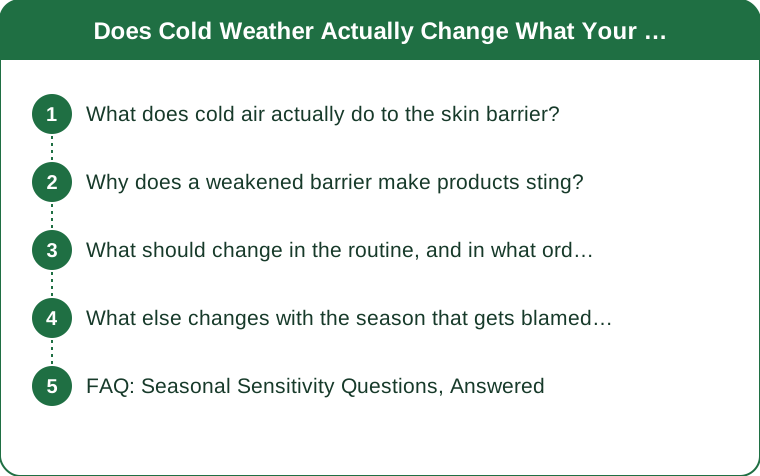
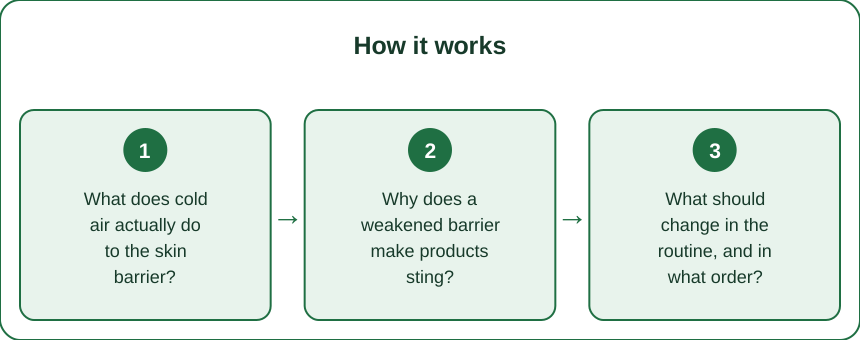
What does cold air actually do to the skin barrier?
It increases water loss and changes the barrier’s physical properties.
Cold air holds far less water than warm air. Absolute humidity falls sharply as temperature drops, and indoor heating then warms that dry air without adding moisture - producing indoor relative humidity that can fall well below comfortable levels.
Dry air increases transepidermal water loss. Water moves from your skin into the surrounding air along a gradient, and a steeper gradient means faster loss. This is measurable and is the core mechanism.
The lipids in the barrier change behaviour with temperature. The lipid matrix between skin cells becomes less fluid in the cold, which affects how well it functions as a seal.
Natural moisturising factor levels drop. The skin’s own humectant compounds are produced in response to conditions, and their levels are typically lower in winter - which is part of why skin feels tight rather than merely dry.
Barrier recovery is slower in dry conditions. Damaged barrier repairs more slowly at low humidity, so irritation that would have resolved in two days in summer takes longer in autumn.
And the transitions are the worst part. Moving between cold outdoor air and heated indoor air repeatedly subjects the skin to rapid changes, and this cycling is harder on the barrier than either condition alone.
Why does a weakened barrier make products sting?
Because the barrier is what controls how much of anything gets in.
An intact barrier limits penetration. The stratum corneum is a genuine physical obstacle, and when it is compromised, actives that previously reached only the surface now penetrate further and faster.
Higher penetration means higher effective concentration. The same 10 percent product delivers more active to living tissue through a compromised barrier, which is functionally a stronger product.
Nerve endings become more accessible. Stinging is a sensory response, and a thinner or damaged barrier means irritants reach the nerve endings that report it.
Acids are the most common culprit. Glycolic, lactic, and salicylic acids at concentrations tolerated in summer are commonly the first thing to sting in autumn - not because they changed but because more is getting in.
Retinoids follow the same pattern. A retinoid tolerated for months can suddenly cause flaking and irritation with the seasonal change, which people frequently misread as a sudden allergy.
And fragrance becomes more reactive. Fragrance is the most common cause of contact reactions in skincare, and a compromised barrier lowers the threshold. A product that was fine in July can become the problem in October with no reformulation.

What should change in the routine, and in what order?
Subtract before you add, and give it two weeks.
First, reduce frequency of actives rather than stopping them. Cutting an acid or retinoid from four nights a week to two is usually enough, and it preserves the benefit. Stopping entirely and restarting later means going through the adjustment again.
Second, switch the cleanser. A foaming cleanser that was fine in humid summer air strips a compromised autumn barrier, and the cleanser is the highest-impact single change in most routines. A cream or gel cleanser with no sulphates is the standard autumn switch.
Third, add occlusion, not just hydration. Humectants like glycerin and hyaluronic acid draw water in but do not hold it there, and in dry air they can pull moisture from deeper skin and lose it to the environment. An occlusive layer on top - a cream with ceramides, squalane, or petrolatum - is what actually retains it.
Fourth, apply moisturiser to damp skin. Within a minute or two of washing, while the skin is still damp, traps significantly more water than applying to dry skin.
Fifth, only then consider adding anything new. Do not introduce a new product while the barrier is compromised - you will not be able to tell whether a reaction is the product or the season.
And give changes two weeks before judging them. Barrier repair takes days to weeks, and skin that feels better in three days often is not yet stable.
What else changes with the season that gets blamed on products?
Six things, all of them environmental rather than cosmetic.
Hot showers. Longer, hotter showers in cold weather strip skin lipids directly, and this is one of the largest autumn factors. Lukewarm and shorter makes a visible difference within a week.
Indoor heating. Forced air heating in particular dries the air substantially, and a humidifier in the bedroom is one of the highest-value interventions for winter skin - it addresses the cause rather than the symptom.
Wind exposure. Wind strips the surface layer of moisture and increases evaporation directly, which is why the cheeks and nose suffer most.
Wool and fabric contact. Scarves, collars, and jumpers introduce mechanical irritation to the face and neck exactly where sensitive skin is thinnest. This is a very common autumn trigger that nobody attributes correctly.
Hard water in winter. Water hardness does not change seasonally, but the amount of hot washing does - and the combination with a compromised barrier makes the effect noticeable.
And sun exposure, which people stop protecting against. UVA passes through cloud and glass year-round, and stopping sunscreen in autumn is a common error that shows up months later. Keep it on.
The pattern across all six: the environment does more than the routine. Changing the shower temperature and adding a humidifier often outperforms changing three products.
FAQ: Seasonal Sensitivity Questions, Answered
How do I tell a seasonal flare from a product reaction?
Timing and distribution. A seasonal flare develops gradually over weeks, affects exposed areas like cheeks and nose most, and coincides with the weather changing. A product reaction is usually faster, follows the application area, and often follows a change in what you are using. If a reaction appears days after a new product, patch testing is the reliable way to distinguish them.
Should I stop actives completely for the winter?
Usually not - reduce frequency instead. Stopping and restarting means repeating the adjustment period each spring, and lower-frequency use maintains most of the benefit while respecting a more fragile barrier.
Does a humidifier actually help?
Yes, and it is one of the few interventions that addresses the cause. Raising bedroom humidity into a moderate range reduces overnight water loss, and many people find it does more than any product change. Clean it regularly - a dirty humidifier introduces its own problems.
A note: persistent stinging, burning, or a rash that does not settle with gentler care deserves a dermatologist rather than another product. This is general information, not medical advice.
TL;DR:
- Cold dry air and indoor heating increase water loss and weaken barrier function - measurably, not just subjectively.
- A weaker barrier lets actives penetrate further, so the same product effectively becomes stronger and stings.
- Reduce active frequency, switch to a gentler cleanser, and add an occlusive layer - in that order.
- Apply moisturiser to damp skin and give any change two weeks before judging it.
- Shower temperature, indoor humidity, and wool contact often matter more than which products you use.
Turn the shower temperature down and put a humidifier in the bedroom this week. Those two changes usually beat any product swap.
Keep Reading
This article is for general informational purposes only and is not medical advice. Always consult a qualified health professional for guidance specific to you.