Why Does My Sensitive Skin Get Worse When the Heating Comes On?
Quick Answer: Indoor heating drops relative humidity from a comfortable 40 to 60% down to 10 to 30%, and dry air pulls water out of your skin faster than it can be replaced. That impairs the skin barrier, which lets irritants in and lets more water out — a loop that produces tightness, flaking and reactivity within days. The fixes are humidity, occlusive moisturiser, and reducing hot water exposure, in that order of impact.
Your skin was fine in September. The heating came on in the first week of October and by the second week everything stings.
The same products you have used all year now burn slightly. Your face feels tight twenty minutes after washing.
You have not developed a new sensitivity. The air in your house changed, and everything downstream of that changed with it.

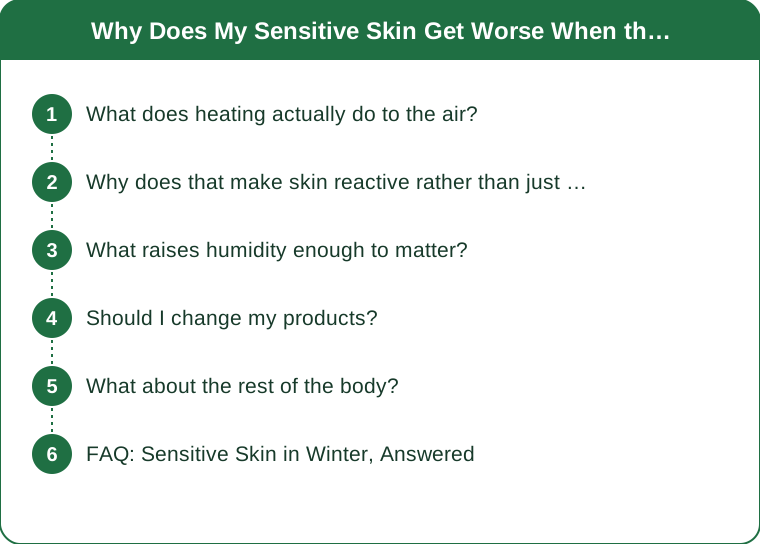
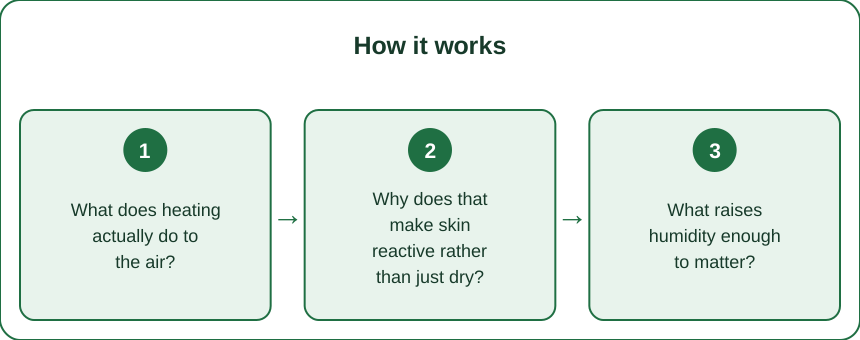
What does heating actually do to the air?
It reduces relative humidity dramatically, and relative humidity is what matters to skin.
Heating air does not remove water from it, but it raises the amount of water the air could hold — so the same absolute moisture becomes a much lower relative humidity. Cold outdoor air brought inside and heated to 21°C can arrive at a relative humidity in the teens, comparable to a desert.
Skin is comfortable between roughly 40 and 60% relative humidity. Below 30%, water evaporates from the skin surface faster than the deeper layers can supply it.
This is why the timing is so consistent. It is not the cold outside, it is the dry inside, which is why the problem is worst for people who spend the most time in heated buildings and why it starts within days of the boiler switching on.
Why does that make skin reactive rather than just dry?
Because dryness and barrier impairment are the same process at different stages.
Your skin barrier is a layer of corneocytes held in a lipid matrix — the common description is a brick wall with mortar. That mortar requires water to stay flexible and continuous.
When water content drops, the lipid matrix becomes disordered and gaps open. Two things then follow: more water escapes through the gaps, accelerating the drying, and irritants that would normally stay on the surface reach living tissue below.
That is the mechanism behind the burns now sensation. Your serum did not change. It is now reaching nerve endings it never previously contacted, because the barrier between them has holes.
It is a self-reinforcing loop, which is why it deteriorates so quickly once it starts — and why interrupting it early is much easier than repairing it later.
What raises humidity enough to matter?
A humidifier does, and most of the folk alternatives do not.
A humidifier is the intervention with the best evidence and the biggest effect. Target 40 to 50%. A bedroom unit running overnight covers the eight hours of continuous exposure that matters most, and it is where most people see the fastest change.
Buy a cheap hygrometer first. They cost very little and they tell you whether you have a problem at all — plenty of homes sit at 35% and need nothing.
Bowls of water on radiators contribute almost nothing in a room of normal size. Drying laundry indoors genuinely does add moisture, and is worth more than the bowls.
Lower the thermostat a degree or two. Every degree of heating lowers relative humidity, so a slightly cooler room is a less drying room. Two degrees is often noticeable.
Close the bathroom door and turn the extractor off after a shower if you want the moisture to reach the rest of the house. Small, free, and it works.

Should I change my products?
Simplify first, then reinforce. Do not go shopping while your barrier is impaired.
Stop actives temporarily. Retinoids, acids and vitamin C all increase transepidermal water loss, and on a compromised barrier they cause the stinging. Pause them for two weeks and reintroduce one at a time.
Switch to an occlusive at night. Humectants like glycerin and hyaluronic acid draw water — but in very dry air with no occlusive over them they can draw it from deeper skin and evaporate it away. A humectant followed by an occlusive works; a humectant alone in dry air can make things worse.
Apply to damp skin, within a minute of washing. This is free and it is one of the highest-impact changes available.
Cut the water temperature. Hot water strips surface lipids directly. Lukewarm showers, shorter, and a gentle non-foaming cleanser — if your cleanser makes skin feel squeaky, it is removing too much.
Do not introduce a new product to fix this. A compromised barrier reacts to almost anything, and you will wrongly conclude you are allergic to something you are not.
What about the rest of the body?
The same mechanism, and the same fixes, with two additions.
Hands are worst hit because they get washed most and have thin skin on the back. Moisturise after every wash, not once a day, and use something ointment-like overnight.
Legs and shins flake first on the body, because they have fewer oil glands than almost anywhere else. Long baths are the usual aggravator.
Static-prone fabrics matter more than people think. Wool directly on reactive skin is a common trigger, and it is mechanical irritation rather than allergy. A smooth base layer underneath solves it entirely.
Fabric softener is worth suspecting. It coats fibres with residue that sits against skin all day, and it is a frequent culprit in people who develop unexplained autumn itching.
FAQ: Sensitive Skin in Winter, Answered
How long does it take to repair a damaged barrier?
Roughly two to four weeks with consistent care — that is the natural turnover time for the outer layer. Improvement in the tight, stinging feeling usually comes within a few days of stopping actives and adding occlusion, but full recovery takes the whole cycle. Do not judge it after three days.
Is a humidifier really worth it, or is that marketing?
For barrier-impaired skin in a heated home, it is one of the few genuinely well-supported interventions. Check with a hygrometer first — if your home sits at 45%, a humidifier will do nothing for you, and the money is better spent on a good occlusive moisturiser.
When should I see a doctor about this?
If you have cracking, bleeding, weeping, or anything that spreads or does not respond in three to four weeks of consistent basic care. Persistent facial redness and reactivity can also be rosacea or eczema rather than simple dryness, and both have specific treatments. This is general information, not medical advice — see a GP or dermatologist if it is not settling.
TL;DR:
- Heating drops indoor humidity to 10 to 30%, well below the 40 to 60% skin needs — the cold outside is not the problem, the dry inside is.
- Dryness and reactivity are the same process. Gaps in the lipid barrier let water out and irritants in, which is why familiar products suddenly sting.
- Pause actives, apply to damp skin, and use an occlusive over your humectant. A humectant alone in very dry air can make things worse.
- Measure with a hygrometer before buying a humidifier — and drop the thermostat a degree, which helps for free.
Do not go shopping for new products while your barrier is impaired. Simplify for two weeks, then reintroduce one thing at a time. This is general information, not medical advice.
Keep Reading
This article is for general informational purposes only and is not medical advice. Always consult a qualified health professional for guidance specific to you.