Sensitive Skin and Hard Water: Your Questions, Answered
Quick Answer: Hard water contains dissolved calcium and magnesium that react with cleansers to leave a residue on skin, and research has linked hard water exposure to increased skin barrier disruption and eczema risk, particularly in children. If your skin feels tight, filmy or itchy after washing and this started after a move, hard water is a genuine suspect. The most reliable first fixes are changing your cleanser to a low-surfactant, non-soap formula and reducing water temperature - both of which cost less than a filter and address the same mechanism.
Same routine. Same products. New postcode.
And suddenly your face feels like it has been wrapped in cling film after every wash.

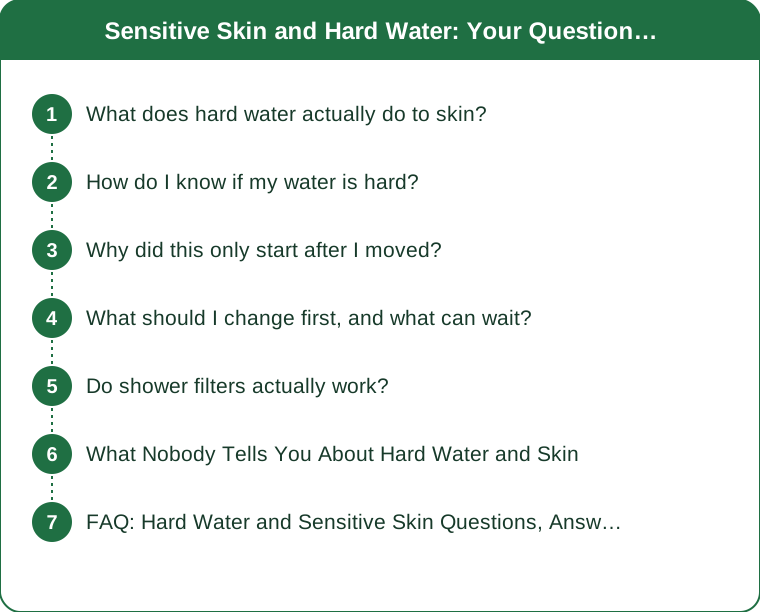
What does hard water actually do to skin?
Hard water is water high in dissolved calcium and magnesium, picked up as it moves through chalk and limestone ground.
Those minerals react with the surfactants in soap and cleansers to form an insoluble residue - the same residue that leaves limescale on a kettle and a film on a shower screen.
That film sits on the skin surface and is not easily rinsed away, which is the mechanism most often proposed for the tight, coated feeling people describe.
Research has associated hard water exposure with skin barrier disruption, and studies have found links between domestic water hardness and eczema prevalence, particularly in infants and children.
Hard water also makes cleansers less effective, so people use more product and wash longer, compounding the effect.
Which means the problem is not only the minerals - it is the interaction between the minerals and what you are washing with. This is general information, not medical advice.
How do I know if my water is hard?
Check your water supplier’s website first. In most regions, hardness data is published by postcode and is free to look up, which is faster and more accurate than guessing.
Look at the kettle. Persistent white scale inside is the clearest domestic indicator there is.
Watch how soap behaves. Hard water produces poor lather and a scummy residue on the bath and shower screen.
Notice the laundry. Towels that feel stiff and scratchy despite softener are a classic hard water sign.
Test strips are cheap if you want a number, and they take a minute.
And note the pattern in your own skin. If tightness appears within minutes of washing and eases once you apply moisturiser, then returns after the next wash, the water contact is doing something.
Why did this only start after I moved?
Because water hardness varies enormously between regions, and moving between a soft water area and a hard water one is a substantial environmental change with no visible signal.
Your products did not change, so you looked at everything else - stress, diet, sleep - which is the usual pattern and the reason the water goes unexamined for months.
The effect also compounds, so it may take a couple of weeks of daily washing before the barrier disruption becomes obvious.
A new home often brings other changes too - different heating, different humidity, a different shower head, a longer shower because the pressure is better - each of which is a variable.
Central heating switching on in autumn adds a second dryness factor on top of the water one, which is why late September is when many people first notice this.
The useful move is to change one thing at a time, starting with the cheapest. This is general information, not medical advice.

What should I change first, and what can wait?
Change the cleanser first. A low-surfactant, non-soap, pH-balanced cleanser produces far less mineral residue than traditional soap, and this is the single highest-value change.
Drop the water temperature second. Hot water strips lipids independently of hardness and increases mineral deposition. Lukewarm, and shorter.
Third, apply moisturiser to damp skin within about three minutes of washing, which is a well-established way to reduce transepidermal water loss.
Fourth, reduce contact time. Long hot showers are the highest-exposure event in most people’s day.
Only then consider a shower filter, which can help but varies widely in effectiveness and needs regular cartridge changes to do anything at all.
A whole-house softener is the thorough option and the expensive one - reasonable if hardness is high and the problem is persistent, but not the first step. This is general information, not medical advice.
Do shower filters actually work?
It depends heavily on what the filter is designed to remove. Many shower filters primarily target chlorine, which is a different issue from hardness.
True water softening requires ion exchange, which removes calcium and magnesium. Most inline shower filters do not do this in any meaningful way at shower flow rates.
Filters that use KDF or similar media can reduce chlorine and some metals, which may help some people’s skin without changing hardness at all.
Cartridge life is short and often ignored, so a filter installed a year ago is likely doing very little now.
Anecdotal improvement is common, but so is the improvement from simultaneously shortening showers and cooling the water - which people usually do at the same time.
Realistic framing: a filter is a reasonable experiment after the cheap changes, not instead of them.
What Nobody Tells You About Hard Water and Skin
Your hair tells you before your skin does. Hair that feels coated, dull and hard to rinse in a new place is usually the first signal, and it appears weeks before people connect the skin symptoms.
The residue is worse with bar soap than with almost anything else, because traditional soap is exactly the chemistry that reacts with calcium. Switching from a bar to a syndet cleanser changes the outcome more than any filter.
Softened water feels slippery and people think it is not rinsing. That slipperiness is the normal feel of skin without mineral residue, and the instinct to keep rinsing is what makes people distrust a softener that is working.
Hard water makes every product perform worse, including shampoo, which is why people in hard water areas use more of everything and then wonder why their skin is stripped.
Temperature interacts with hardness. Hotter water deposits more scale - this is visible in any kettle - and the same mechanism applies to the shower.
Face washing at the basin is often the worst offender, not the shower, because it happens twice a day and usually with the most stripping product in the house.
And the seasonal timing is a real confounder. Skin problems appearing in September get blamed on the water in a new home when heating, humidity and the seasonal drop in outdoor humidity are all changing at once. Change one variable at a time. This is general information, not medical advice.
FAQ: Hard Water and Sensitive Skin Questions, Answered
Can hard water cause eczema?
Research has found associations between domestic water hardness and eczema prevalence, especially in children, and studies have shown hard water can increase skin barrier disruption. Association is not the same as cause for any individual, and eczema is multifactorial. If you have persistent eczema, see a healthcare professional.
Will a water softener fix my skin?
It may help, and some people report substantial improvement. Trials on softeners for eczema have had mixed results. It is a significant expense, so try cleanser and temperature changes first.
Is bottled water for face washing worth it?
As a short experiment it is a reasonable diagnostic - wash with soft bottled water for a week and see whether the tight feeling changes. As an ongoing routine it is expensive and wasteful.
Does hard water affect hair too?
Yes, commonly - mineral deposit leaves hair feeling coated, dull and harder to rinse, and it is often the first thing people notice after a move.
What kind of cleanser should I use in a hard water area?
A non-soap, low-surfactant, pH-balanced formula. Cream and lotion cleansers generally leave less residue than foaming ones, and micellar or oil cleansers can be rinsed with less water contact.
How long until my skin settles after changing things?
Skin barrier recovery typically takes a couple of weeks, so give any single change two to four weeks before judging it. Changing four things at once tells you nothing about which one worked.
When should I see a professional?
If skin is cracked, weeping, bleeding, infected, or if the itch is disrupting sleep. Also if you have tried the simple changes for a month with no improvement. This is general information, not medical advice.
TL;DR:
- Hard water minerals react with cleansers to leave a residue linked to barrier disruption.
- Check your supplier’s published hardness data before buying anything.
- Change the cleanser first - non-soap, low-surfactant - then lower the water temperature.
- Moisturise damp skin within about three minutes of washing.
- Most shower filters target chlorine, not hardness; softeners use ion exchange.
- Autumn heating is a second dryness variable, so change one thing at a time.
If your skin changed when your postcode did, test the water before you replace the shelf. This is general information, not medical advice.
Keep Reading
This article is for general informational purposes only and is not medical advice. Always consult a qualified health professional for guidance specific to you.