Sensitive Skin in the First Weeks of Heating Season: What Changes and Why
Quick Answer: Indoor heating drops relative humidity to 20 or 30 percent, which increases water loss through the skin barrier faster than the barrier can adapt. The result is a reactivity flare that appears one to three weeks after the heating starts, usually mistaken for a product reaction. Simplify the routine, add occlusion, and address the room.
Nothing in your routine changed and your skin has started reacting to everything.
You are mentally running through recent purchases looking for the culprit.
Check the date the heating came on instead. It is almost certainly one to three weeks ago.

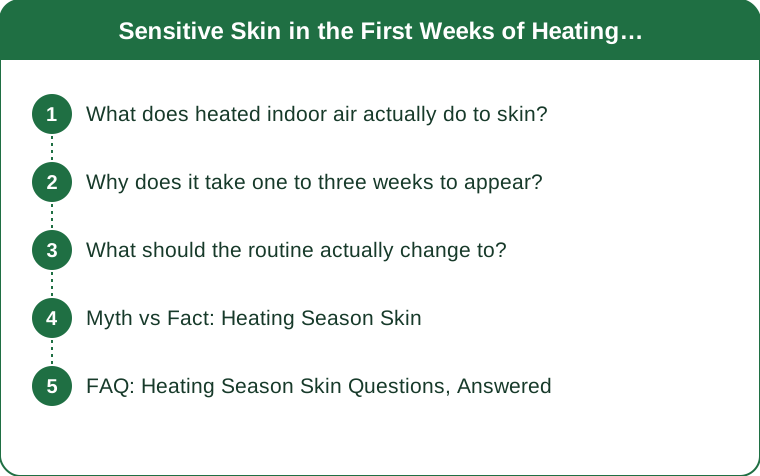
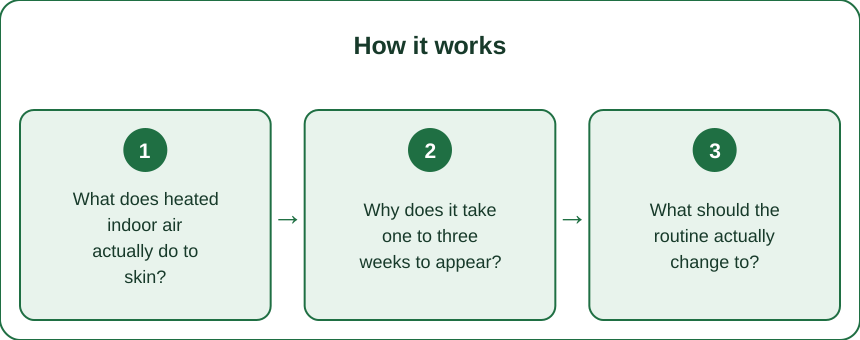
What does heated indoor air actually do to skin?
It accelerates transepidermal water loss, which is the constant, normal movement of water from the deeper layers out through the stratum corneum and into the air.
The rate of that loss depends on the humidity gradient between your skin and the air. At 50 percent relative humidity, the gradient is modest. At 20 percent, it is steep, and water leaves considerably faster.
Your barrier can compensate to a point by increasing lipid production, but that adaptation takes weeks and it is exactly the process that is impaired in sensitive skin types.
When loss outpaces the barrier’s capacity, the stratum corneum’s water content drops, corneocytes shrink slightly, and small gaps open between them. Those gaps let irritants reach nerve endings that they would normally never get near — which is why products you have used safely for years suddenly sting.
The sting is not evidence that the product changed. It is evidence that the barrier stopped keeping it out.
Why does it take one to three weeks to appear?
Because it is a cumulative deficit rather than an event.
Day one of heating produces slightly more water loss than the barrier replaces. So does day two. The deficit is imperceptible daily and compounds steadily, and it crosses the threshold where nerve endings become exposed somewhere between one and three weeks in depending on how robust your barrier was to start with.
That delay is what makes the cause so hard to identify. Nobody connects a reaction in late October to a boiler that came on in early October, so the search naturally lands on whatever product was introduced most recently.
There is a compounding factor: hot showers. Heating season and hot-shower season begin at the same time, and hot water strips barrier lipids directly. Two independent barrier insults starting the same week produce a flare that neither would have caused alone.
The shower point deserves more weight than it usually gets. Water above about 40C removes stratum corneum lipids measurably, and the sensation of a hot shower being soothing on dry skin is real and completely at odds with what it is doing. People with sensitive skin often report the flare being worst in the days after they started taking longer showers because the bathroom was the warmest room in the house.
And a third: you also started wearing wool, which is a mechanical irritant on skin whose barrier is already compromised. Three things, all beginning within days of each other, none of them a new product.

What should the routine actually change to?
Simplify aggressively, then add occlusion. In that order.
Stop all actives for two weeks — retinoids, acids, vitamin C, anything exfoliating. This is not permanent and it is not a setback. A compromised barrier cannot tolerate them, and continuing is what turns a two-week flare into a two-month one.
Switch to a cream cleanser or a low-foaming gel. Anything that produces a satisfying amount of foam is using surfactants that remove lipids you cannot currently spare.
Moisturize on damp skin within 60 seconds of washing. This is the highest-return single change available — applying to damp skin traps the water still on the surface and roughly doubles the hydration effect of the same product.
Add an occlusive at night. A thin layer of an ointment-type product over your moisturizer physically slows water loss while the barrier rebuilds. This is the specific intervention for this specific problem, and two weeks of it resolves most heating-season flares.
Look for ceramides, glycerin, and squalane on the ingredient list, and avoid fragrance entirely during a flare. Fragrance is worth singling out because it is the most common cause of contact reactions in cosmetic products, and a compromised barrier is exactly the condition under which a previously tolerated fragrance stops being tolerated.
Expect the routine to look boring for two weeks. Cleanser, moisturizer, occlusive, sunscreen in the morning — four products, no actives, no experimentation. The single most common reason these flares drag on for months is that people reintroduce something at day ten because the skin looked better, which it did precisely because nothing was being added to it.
This is general information, not medical advice. Persistent flares, broken skin, or anything spreading warrants a dermatologist rather than another product change.
Myth vs Fact: Heating Season Skin
Myth: You have developed a new sensitivity to a product. Fact: True new sensitization is uncommon and usually presents as a defined rash rather than general reactivity. Generalized stinging that appears seasonally is a barrier problem.
Myth: Drinking more water fixes dry skin. Fact: Systemic hydration has very little effect on stratum corneum water content in people who are not dehydrated. The water is leaving through the surface, and the answer is at the surface.
Myth: You need a heavier moisturizer. Fact: You need a more occlusive one, which is not the same thing. A thick cream that is not occlusive slows water loss less than a thin layer of ointment.
Myth: The flare means you should exfoliate the flaking. Fact: The flaking is the barrier trying to reorganize. Exfoliating it removes the layer doing the protecting and reliably extends the flare by weeks.
FAQ: Heating Season Skin Questions, Answered
How much does a humidifier help?
Substantially, and it is the only intervention that addresses the cause rather than the effect. Target 40 to 50 percent relative humidity in the room you sleep in — that is where the longest continuous exposure happens.
How do I tell this apart from eczema or rosacea?
Seasonal barrier flares are diffuse, symmetrical, and present mainly as stinging and tightness rather than defined patches. Eczema tends to appear in characteristic locations with clear borders, and rosacea involves persistent redness and visible vessels. If what you are seeing has a shape, it is worth a professional opinion.
When can I restart my actives?
When stinging has stopped completely for a full week. Reintroduce one product at a time at half your previous frequency, waiting two weeks between additions.
Should I change my shower routine?
Yes. Lukewarm rather than hot, under ten minutes, and moisturize within a minute of getting out. Shower temperature is the second-largest lever after room humidity and it costs nothing.
TL;DR:
- Heating drops indoor humidity to 20 to 30 percent, and water leaves the skin faster than the barrier can replace it.
- The flare appears one to three weeks later, which is why it gets blamed on a product instead of the boiler.
- Stop all actives for two weeks, switch to a gentle cleanser, and moisturize on damp skin within 60 seconds.
- Add a nightly occlusive layer, and run a humidifier at 40 to 50 percent in the bedroom.
Every autumn a large number of people conclude they have become allergic to a moisturizer they have used for three years. Check the heating date first — the timing is remarkably consistent, and the fix takes about two weeks.
Keep Reading
This article is for general informational purposes only and is not medical advice. Always consult a qualified health professional for guidance specific to you.