How to Introduce Retinol Without Triggering a Sensitive Skin Flare-Up
Quick Answer: Start with a low-strength retinol (0.01-0.03%) once a week, buffered under moisturizer, and increase frequency only after 2 weeks with zero irritation. Sensitive skin usually can’t handle daily retinol from day one — but most can build up to 2-3x a week over 6-8 weeks.
You’ve heard retinol is the gold standard for aging and texture, and you’ve also heard it wrecks sensitive skin. Both are true depending entirely on how you introduce it. The ingredient isn’t the problem — the typical ‘apply nightly’ instruction on the box is.

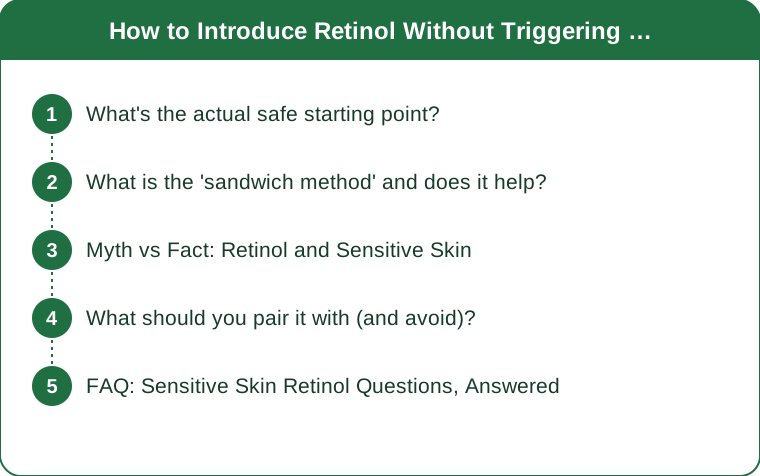
What’s the actual safe starting point?
0.01-0.03% retinol, once a week, for 2 weeks. That’s a fraction of what most boxes recommend, and that’s the point — sensitive skin needs a much longer runway to build tolerance.
Apply to fully dry skin (wet skin absorbs faster and harsher) and always follow immediately with a bland moisturizer. If week 2 passes with no redness, flaking, or stinging, move to twice a week. Anything less patient skips the adaptation window your skin barrier actually needs.
What is the ‘sandwich method’ and does it help?
The sandwich method means moisturizer, then retinol, then moisturizer again — cushioning the active between two protective layers instead of applying it directly to bare skin.
It measurably softens the delivery: you get the benefit at a slower absorption rate, which is exactly what irritation-prone skin needs. Most dermatology-adjacent guidance now recommends this as the default entry method for reactive skin types, not just a fallback for people who’ve already had a flare-up.

Myth vs Fact: Retinol and Sensitive Skin
Myth: Purging and irritation are the same thing, and both are normal. Fact: Purging is short-lived breakout activity in acne-prone skin as cell turnover speeds up — it resolves in 2-4 weeks. Irritation is redness, burning, and flaking that gets worse with continued use. If it’s escalating past week 3, that’s not purging — stop and reassess.
Myth: You should feel a slight tingle for it to be working. Fact: A working retinol is often undramatic. Tingling that’s noticeable every use is a sign of overuse, not efficacy.
Myth: Sensitive skin should avoid retinol entirely and use only ‘gentle’ alternatives. Fact: Bakuchiol and other alternatives are milder but also less proven. Most sensitive skin can use real retinol — just on a much slower ramp.
What should you pair it with (and avoid)?
Pair with: a ceramide-based moisturizer and, in the morning, a mineral SPF 30+ — retinol increases sun sensitivity, and skipping SPF is the single most common reason people think retinol ‘broke’ their skin.
Avoid combining with: vitamin C, exfoliating acids (AHA/BHA), and benzoyl peroxide on the same night. Layering multiple actives is the most common cause of a flare-up that gets blamed on the retinol alone. Keep other actives to alternate nights while you’re still building tolerance.
FAQ: Sensitive Skin Retinol Questions, Answered
How long until I see results?
Visible texture and tone changes typically take 8-12 weeks of consistent use. Sensitive skin’s slower ramp-up means the timeline stretches to closer to 12-16 weeks — patience is part of the method, not a sign it’s failing.
What do I do if I get a flare-up anyway?
Stop for a full week, moisturize only, and restart at half the frequency you were at. Most flare-ups from over-ambitious pacing resolve within days once you back off.
Can I use retinol if I have eczema or rosacea?
This is a genuine see-a-professional situation — a dermatologist can advise on timing around flares and may recommend a prescription-strength alternative formulated for reactive skin. This is general information, not medical advice.
TL;DR:
- Start at 0.01-0.03%, once a week, on dry skin, buffered with moisturizer
- Use the sandwich method (moisturizer-retinol-moisturizer) to soften delivery
- Purging fades by week 4; worsening irritation past week 3 means stop
- Never skip morning SPF — most ‘retinol damage’ is actually sun sensitivity
Slow is the whole strategy here. Sensitive skin and retinol aren’t incompatible — impatience and retinol are.
Keep Reading
This article is for general informational purposes only and is not medical advice. Always consult a qualified health professional for guidance specific to you.