What to Do in the First 48 Hours of a Skin Reaction
Quick Answer: Stop all active ingredients immediately and reduce to three products: a non-foaming gentle cleanser, a bland moisturiser with no fragrance or actives, and a mineral sunscreen. Do not add anything new, including soothing products, because a compromised barrier reacts to things it normally tolerates. Most simple irritant reactions settle within three to seven days on this approach. Reactions with swelling, spreading rash, blistering, or any breathing difficulty need medical attention rather than a routine change.
The most common mistake is treating a reaction by adding products, which extends it substantially.
This blog has covered why sensitive skin can suddenly react to a product used for months, why your skin reacts days after a new product rather than immediately, and why sensitive skin flares seasonally. This is the acute response protocol.

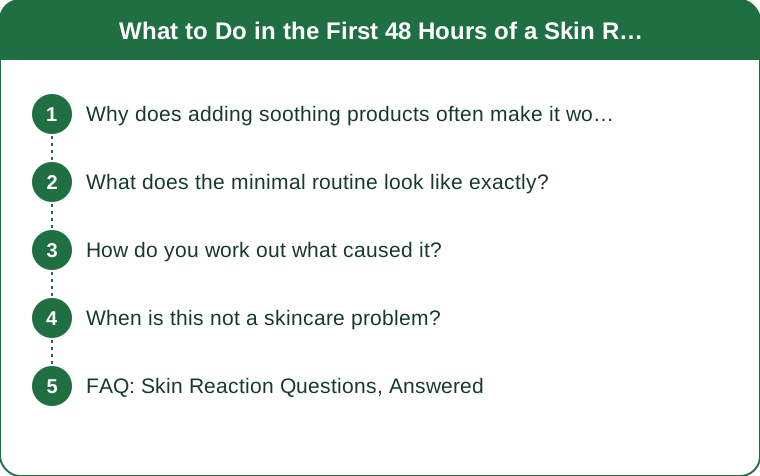
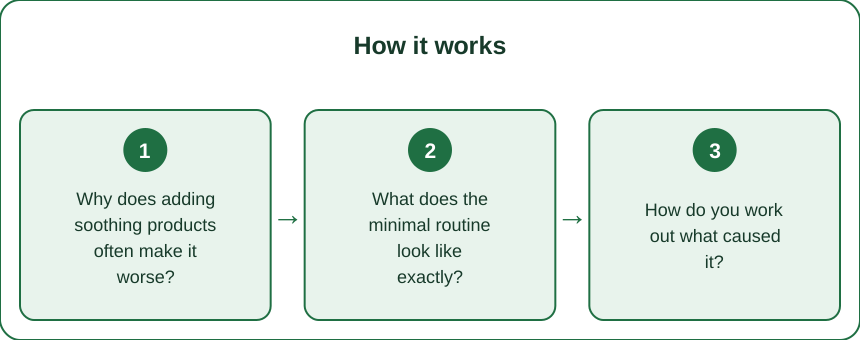
Why does adding soothing products often make it worse?
Because a compromised barrier has lost its ability to be selective about what gets in.
Your skin barrier normally keeps most of what you apply on the surface. When it is disrupted, penetration increases substantially, which means ingredients that were always tolerable now reach deeper layers at higher concentrations.
This is why a product you have used for years can suddenly sting. The product did not change. Your barrier did, and now the same formula is behaving differently.
Soothing products still contain ingredients. Botanical extracts, essential oils, and even some preservatives are common triggers, and compromised skin is far more likely to react to any of them. A product marketed as calming is not chemically inert.
Every new product is a new variable. If you add three things and it gets worse, you have no idea which one did it, and you have now potentially sensitised yourself to all three.
Subtraction is diagnostic as well as therapeutic. Reducing to a minimal routine both removes the likely cause and gives you a clean baseline to reintroduce from.
And barrier repair is largely a matter of not interfering. Skin repairs its barrier on its own over roughly three to seven days if you stop disrupting it. Most of what you can do is get out of the way.
What does the minimal routine look like exactly?
Three products, twice a day, and nothing else at all.
A non-foaming, fragrance-free cleanser, once daily. Cream or lotion textures rather than gels or foams. Foaming agents are surfactants and surfactants strip lipids, which is the opposite of what a damaged barrier needs. Rinse with lukewarm water; hot water increases irritation measurably.
Consider skipping cleanser entirely in the morning. Water alone is sufficient for most people during a flare and it removes a variable.
A bland moisturiser with no fragrance, no essential oils, and no actives. Look for ceramides, glycerin, and petrolatum, which support barrier repair rather than doing anything active. Apply to slightly damp skin, generously, twice a day.
A mineral sunscreen with zinc oxide or titanium dioxide. Compromised skin is more sun-sensitive and UV exposure worsens inflammation. Mineral filters are generally better tolerated than chemical ones on reactive skin.
Nothing else. Not a serum, not an oil, not a mask, not a toner. This includes products you consider gentle and products someone recommended for exactly this. Two weeks of nothing is a short time and it resolves most reactions.
Stop physical exfoliation and any device. Brushes, cloths, and tools all add mechanical stress to skin that cannot currently tolerate it.
And use lukewarm water everywhere, including showers. Hot water on the face and body both increase transepidermal water loss and worsen barrier disruption.

How do you work out what caused it?
By tracking backwards with the right time window, which is longer than most people assume.
Irritant reactions appear within minutes to hours. These are dose-dependent, usually from something too strong or too frequent, and they typically show as stinging, burning, redness, and dryness in the exact area applied.
Allergic contact reactions appear 24 to 72 hours later. This is the delayed immune response and it is why people so often blame the wrong product. Something applied Monday can produce a reaction Wednesday, by which point you have used many other things.
So look at everything from the past week, not the past day. Skincare, but also detergent, fabric softener, a new pillowcase, sunscreen, hair products that run down your face in the shower, and anything applied by someone else.
Write it down while it is fresh. A dated list of what you used and when is enormously more useful than memory a week later, and it becomes valuable if this recurs.
Reintroduce one product at a time, five to seven days apart. Faster than that and a delayed reaction from product one will be blamed on product two.
Patch test on the inner forearm for five days before returning anything to your face. Twice daily on the same spot. This is slow and it is the only reliable method.
And consider non-product causes. Seasonal changes, indoor heating starting, hard water, illness, stress, hormonal cycles, and diet changes all affect barrier function. A reaction with no product change often has one of these behind it.
When is this not a skincare problem?
There is a clear list, and getting it wrong costs time at best.
Seek urgent medical care for: any difficulty breathing, swelling of the lips, tongue, or throat, or a rash spreading rapidly across the body. These can indicate a systemic allergic reaction and are emergencies.
See a doctor promptly for: blistering, weeping or crusting skin, a rash spreading beyond where anything was applied, fever alongside a rash, significant swelling around the eyes, or signs of infection such as warmth, pus, or increasing pain.
See a dermatologist if it has not improved in one to two weeks on a minimal routine, or if reactions keep recurring without an identifiable cause. Patch testing by a dermatologist can identify specific allergens and it is far more reliable than home guesswork.
Recurring unexplained reactions may not be reactions at all. Rosacea, perioral dermatitis, seborrhoeic dermatitis, and eczema all present in ways that get self-diagnosed as sensitivity, and all have specific treatments that a minimal routine will not deliver.
Do not use prescription steroid creams left over from something else. Topical steroids on the face have specific risks and using the wrong strength or duration can make several of the above conditions considerably worse.
This is general information, not medical advice. Anything persistent, severe, spreading, or worrying should be seen by a doctor or dermatologist rather than managed from an article.
FAQ: Skin Reaction Questions, Answered
What should I put on irritated skin?
As little as possible. A non-foaming fragrance-free cleanser, a bland moisturiser with ceramides or petrolatum, and a mineral sunscreen. Adding soothing products often prolongs the reaction because a damaged barrier absorbs more of everything.
How long does a skin reaction take to calm down?
Most simple irritant reactions settle within three to seven days on a minimal routine. If there is no improvement after one to two weeks, or if it is blistering, spreading, or weeping, see a doctor.
Why did my skin react days after using a new product?
Allergic contact reactions appear 24 to 72 hours after exposure, not immediately. That delay is why people so often blame the wrong product. Look back across the whole week, not just yesterday.
TL;DR:
- Subtract, do not add. Reduce to a gentle non-foaming cleanser, a bland moisturiser, and a mineral sunscreen.
- A damaged barrier absorbs more of everything, which is why even soothing products can make it worse.
- Look back a full week, not a day. Allergic reactions surface 24 to 72 hours after exposure.
- Reintroduce one product every five to seven days, patch tested on the forearm first.
Swelling, blistering, spreading rash, or any breathing difficulty is a medical issue, not a routine problem. Get it seen.
Keep Reading
This article is for general informational purposes only and is not medical advice. Always consult a qualified health professional for guidance specific to you.