Why Does Sensitive Skin Get Worse the Week the Heating Comes On
Quick Answer: Indoor heating drops relative humidity sharply, which pulls moisture out of the outer skin layer faster than it can be replaced. A compromised barrier lets irritants penetrate more easily and loses water faster, so products you have used for months suddenly sting. The cause is the environment, not the product, and the fix is barrier repair rather than elimination.
Everything was fine. The temperature dropped, the heating came on, and within a week your face is tight, flaky in places, and the moisturizer you have used since spring now stings when you apply it.

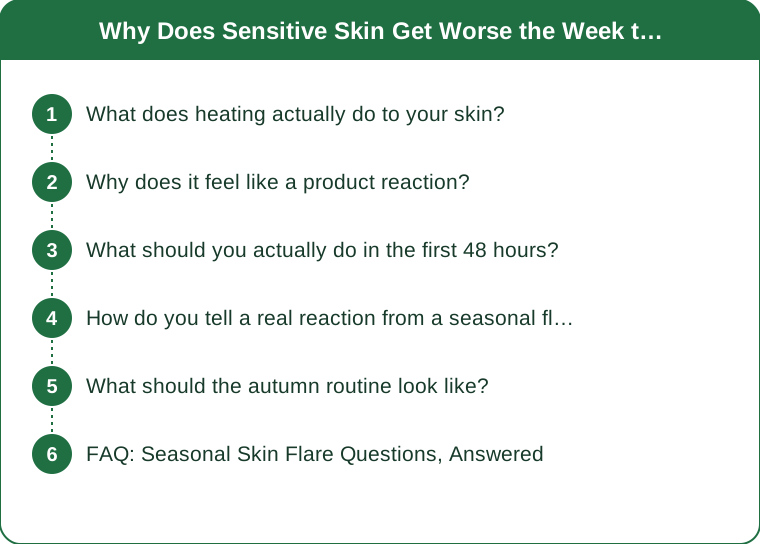
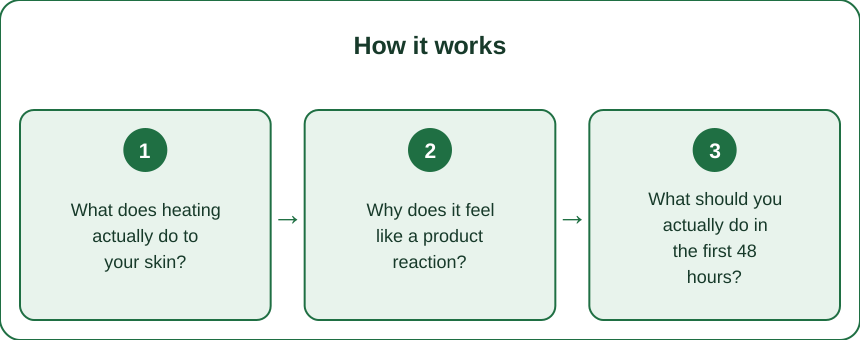
What does heating actually do to your skin?
It changes the humidity, and humidity is the variable your skin barrier is most sensitive to.
Heating a room without adding moisture drops relative humidity substantially — indoor levels in heated buildings commonly fall well below what skin is comfortable with. Water moves from your skin into dry air faster than your skin can replace it, a process called transepidermal water loss.
The outer layer of skin depends on adequate water content to stay flexible and intact. Below a certain level it becomes stiff, develops microscopic cracks, and stops functioning as a barrier.
Once the barrier is compromised, everything else follows. Ingredients that previously stayed on the surface now penetrate to layers with nerve endings, which is why familiar products sting. Water escapes faster, which accelerates the drying. And the irritation itself triggers inflammation, which further impairs the barrier.
That loop is why the flare escalates over a week rather than arriving all at once, and why it does not resolve on its own once the weather stays cold.
Why does it feel like a product reaction?
Because the symptoms are identical, and that misdiagnosis leads people in exactly the wrong direction.
Stinging, redness, tightness, and flaking are what a genuine irritant reaction produces. They are also what a compromised barrier produces in response to products that are not irritants at all.
The distinguishing feature is the pattern. A true reaction to a new product starts after introducing something new, is often localized to where it was applied, and resolves when you stop. A seasonal barrier flare starts with a weather change, affects multiple products at once, and involves things you have used for months without issue.
The second clue: a barrier flare typically shows up on the areas most exposed to dry air and temperature swings — cheeks, around the nose, and the area between the eyebrows — rather than exactly where a product was applied.
Why the misdiagnosis matters: the response to a product reaction is elimination, and eliminating your moisturizer during a barrier flare removes the thing that would repair it. People routinely strip their routine back to nothing at precisely the moment their skin needs more support, and the flare gets considerably worse.
What should you actually do in the first 48 hours?
Simplify, but do not strip.
Pause actives. Retinoids, exfoliating acids, vitamin C, and anything described as brightening or resurfacing. These are fine on an intact barrier and genuinely aggravating on a compromised one. This is a pause of one to two weeks, not a permanent removal.
Keep and increase moisturizer. This is the counterintuitive part. Look for ceramides, glycerin, hyaluronic acid, squalane, and petrolatum — ingredients that either replace what the barrier is missing or reduce water loss from it.
Apply to damp skin. Within about a minute of washing, while skin still holds water. This roughly doubles the effectiveness of most moisturizers because you are sealing water in rather than adding it to a dry surface.
Switch to a gentler cleanser and use lukewarm water. Hot water strips surface lipids, and hot showers are exactly what people start taking when it gets cold.
Add an occlusive at night on the worst areas — a thin layer of a plain petrolatum-based product over your moisturizer. It is unglamorous and it is the single most effective thing available for a compromised barrier.
As general information rather than medical advice: if skin is cracking, weeping, spreading, or not improving over one to two weeks of gentle care, that is a dermatologist conversation rather than a product one.

How do you tell a real reaction from a seasonal flare?
Five questions that resolve it in most cases.
Did anything new go on your skin in the last two weeks? Including laundry detergent, a new pillowcase, a different sunscreen, or a hand cream that transfers to your face. If yes, a reaction is plausible.
Did it start within a few days of a weather or heating change? A barrier flare tracks the environment closely.
Is more than one previously-fine product now uncomfortable? A true allergy is to one ingredient. Multiple products becoming intolerable at once points to the barrier, not to the products.
Where is it? A reaction usually maps to where a product was applied. A barrier flare shows up on the most exposed and thin-skinned areas regardless of application pattern.
Does a plain occlusive make it better within a day or two? If a barrier-repair approach helps quickly, the diagnosis is confirmed. If it makes no difference or worsens, that shifts the picture.
And the general note about delayed reactions: a true allergic contact reaction often appears days after exposure rather than immediately, which is why people frequently blame the wrong product. If you do suspect a genuine reaction, patch testing on the inner arm for several days is far more informative than guessing.
What should the autumn routine look like?
Fewer steps, heavier textures, and a couple of environmental changes.
Morning:
- Rinse with lukewarm water, or a gentle cream cleanser if you need one
- Hydrating layer on damp skin — something with glycerin or hyaluronic acid
- Moisturizer, heavier than your summer one
- Sunscreen, which people drop in autumn and should not
Evening:
- Gentle cleanser to remove sunscreen and the day
- Moisturizer on damp skin
- Occlusive on top, at least while the flare settles
Environment, which matters as much as the products:
- A humidifier in the bedroom. Eight hours a night in humidified air is the highest-impact change available and it addresses the actual cause rather than the symptoms
- Lukewarm showers rather than hot, and shorter
- Moisturize the body within a minute of getting out, not later
Reintroduce actives slowly once the skin is calm — one product, twice a week, and build from there. Going straight back to a full active routine is how people cycle through this three times a winter.
And a timing note: this arrives before you expect it. The first flare usually comes with the first cold snap and the first day the heating runs, which in much of the US is well before anyone thinks of it as winter. Switching to a heavier moisturizer in early September rather than in November prevents most of it.
FAQ: Seasonal Skin Flare Questions, Answered
Should I stop using my retinoid completely for the winter?
Usually not — a pause of one to two weeks while the barrier recovers, then a reduced frequency, works for most people. Many find that using it two or three nights a week through winter instead of nightly, with a heavier moisturizer, keeps the benefit without the flare. If it consistently causes problems, that is worth discussing with a dermatologist rather than pushing through.
Does a humidifier really make a difference?
For barrier-related dryness, it is one of the most effective interventions available, because it treats the cause rather than compensating for it. A bedroom unit running overnight covers the longest continuous stretch you spend in one environment. Keep it clean — a dirty humidifier creates a different problem.
Why does my skin sting only at night?
Usually because the evening routine involves more active products, cleansing has just removed surface lipids, and skin temperature is higher after a warm shower, which increases penetration and sensation. Cooler water, a gentler cleanser, and moisturizing immediately rather than after a delay usually resolves it.
TL;DR:
- Indoor heating drops humidity, which pulls water from the skin faster than it can be replaced
- A compromised barrier makes familiar products sting, which people misread as a new product reaction
- Pause actives, keep and increase moisturizer, apply to damp skin, and add an occlusive at night
- A bedroom humidifier addresses the cause rather than the symptoms and is the highest-impact single change
The products did not turn on you. The air did, and the fix is supporting the barrier rather than stripping the routine back at exactly the moment your skin needs more from it.
Keep Reading
This article is for general informational purposes only and is not medical advice. Always consult a qualified health professional for guidance specific to you.