Why Does Sensitive Skin Get Worse Every Time You Travel?
Quick Answer: Travel changes several barrier-relevant variables at once — water hardness, cabin humidity, ambient temperature, sleep, and stress — while you keep your products constant. Because you did not change any product, it is easy to conclude the reaction came from nowhere. In practice, hard water and dry cabin air are the two biggest culprits, and both are addressable.
The confusing part about travel flares is that they violate the rule you have learned to live by: introduce one product at a time and you will know what caused a reaction. On a trip you introduced nothing, and reacted anyway.
You introduced a great deal — it just was not in your toiletry bag. Here is what actually changed, answered as the questions people ask when it happens. This is general information, not medical advice; see a dermatologist for persistent or severe reactions.
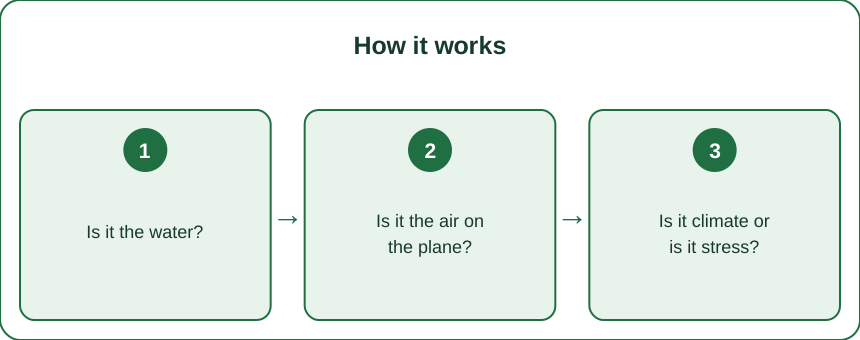
Is it the water?
How much does water hardness actually matter?
More than most people expect. Hard water is high in calcium and magnesium, and it interacts with cleansers to leave a mineral and surfactant residue on the skin. Research has linked hard water exposure to impaired skin barrier function and to eczema flares, particularly in people who already have a compromised barrier.
If you have moved from a soft-water area to a hard-water one — or the reverse — your usual cleanser is behaving differently than it does at home.
How would I know if that is the problem?
Two signs. Your skin feels tight and squeaky after washing, which it does not at home. And a bar soap or foaming cleanser lathers poorly and leaves a film — that film is the residue.
What can I do about it in a hotel?
Use micellar water or a no-rinse cleanser for one of your two daily cleanses. Removing water from the equation entirely is the most direct fix, and it takes no extra luggage.
Rinse with bottled water for the final rinse if the difference is severe. It feels excessive; it also works.
Moisturize on damp skin within about a minute of washing, which matters more in hard water than soft because the residue accelerates moisture loss.
Is it the air on the plane?
How dry is cabin air really?
Commercial cabin humidity typically sits between 10 and 20 percent, which is drier than most deserts. A long flight is several hours of accelerated transepidermal water loss.
Does that alone cause a reaction?
Not usually on its own, but it lowers your threshold for everything that follows. You land with a barrier that is already compromised, and then encounter unfamiliar water, a different climate, and a hotel’s laundry detergent on the pillowcase. Any one of these might have been fine on its own.
What actually helps in flight?
An occlusive layer over your usual moisturizer — a balm or ointment on the drier areas — because occlusion physically slows water loss in a way a lotion does not. Reapply midway through a long flight.
Drink water, though the effect on skin specifically is modest compared to the topical approach. Skip alcohol, which is genuinely dehydrating and disrupts sleep on top of it.
Avoid the temptation to try a sheet mask for the first time in flight. Novel products in a compromised state is the wrong combination, and airplane lighting makes it hard to notice early irritation.

Is it climate or is it stress?
How much does a change in climate matter?
A lot, and in both directions. Moving to a humid climate increases sweating and can trigger heat-related irritation; moving to a dry or cold one accelerates barrier water loss. Sudden changes are harder on skin than the absolute conditions.
Altitude compounds dryness, and increased UV at altitude or lower latitude is frequently underestimated — a mild sunburn you barely registered will make everything else feel worse.
Does stress genuinely affect skin, or is that a cliché?
It is well documented. Stress elevates cortisol, which is associated with impaired barrier recovery and increased inflammatory response. Travel stress is a real physiological input, not a figure of speech — early flights, disrupted schedules, unfamiliar environments.
What about sleep?
Barrier repair happens largely during sleep, and travel disrupts both duration and timing. A short night before a flight plus a night in an unfamiliar bed plus time zone shift is a meaningful reduction in repair capacity at exactly the moment demand is highest.
So which one is it, usually?
Usually not one. The typical travel flare is four or five sub-threshold stressors arriving together, which is precisely why it feels like it came from nowhere.
What should I actually change about my travel routine?
Should I bring different products?
Bring the same actives you use at home, but pause the strongest ones for the first two or three days. Retinoids, exfoliating acids, and vitamin C are the products most likely to tip an already-stressed barrier into visible irritation. Resume once your skin has adapted.
Add one thing you may not use at home: a plain occlusive balm. It is the most useful single item in a travel skincare bag.
Should I simplify the routine?
Yes. A travel routine of gentle cleanser, moisturizer, occlusive where needed, and sunscreen handles almost everything. Complexity is what makes it impossible to identify the culprit when something does go wrong.
What about hotel-provided products?
Skip them. Hotel soaps and shampoos are typically fragranced and formulated for broad appeal rather than for sensitive skin. This includes the laundry detergent residue on towels — if you are highly reactive, patting dry with your own soft cloth is a reasonable precaution.
How long should it take to settle?
Most travel flares calm within three to five days of arriving, or within a week of getting home, provided you have simplified and kept the barrier supported. If a reaction persists beyond that, or involves significant swelling, blistering, or spreading, see a doctor — that is no longer a travel-adaptation issue. This is general information, not medical advice.
FAQ: Travel and Sensitive Skin, Answered
Can I prevent travel flares entirely?
Not entirely, but you can reduce them substantially: pause actives for the first few days, add an occlusive, use micellar cleansing where the water is hard, and protect sleep where you can. Most people find this cuts the severity considerably even when it does not eliminate the flare.
Is it worth bringing a travel humidifier?
For dry-climate or long trips, some people find it genuinely helpful, particularly for overnight. For a two-night trip it is usually not worth the luggage — an occlusive balm at bedtime achieves much of the same effect.
Why is my skin fine on the trip and reacts when I get home?
Barrier damage accumulates and shows up on a delay, often two to four days after the exposure. Arriving home is frequently when the reaction from the flight and the first days finally surfaces, which is why the timing seems backwards.
TL;DR:
- Travel changes water hardness, humidity, climate, sleep, and stress simultaneously while your products stay constant.
- Hard water leaves a residue that impairs the barrier; micellar cleansing or a bottled final rinse solves it.
- Cabin humidity of 10 to 20 percent means you land with a barrier already compromised — use an occlusive, not just a lotion.
- Pause retinoids, acids, and vitamin C for the first two or three days, skip hotel products, and simplify.
- Reactions typically settle in three to five days; longer or severe ones warrant a doctor.
Nothing went wrong with your routine. Five things changed at once and none of them were in your bag — which is why the fix is about supporting the barrier, not hunting for a bad product.
Keep Reading
This article is for general informational purposes only and is not medical advice. Always consult a qualified health professional for guidance specific to you.