Why Does Sensitive Skin React to Laundry Detergent and Not Your Skincare?
Quick Answer: Laundry residue sits against your skin for 16 hours a day — far longer than any skincare product — across your entire body, under friction and warmth. The usual culprits are fragrance, optical brighteners and fabric softener, all of which are designed to remain in the fabric after rinsing. If your reaction pattern follows where clothing is tight rather than where you apply products, strip your laundry routine before changing another serum.
Your skincare is fragrance-free, minimal and dermatologist-recommended.
Your skin is still angry, mostly on your torso and back.
Those are the areas where fabric touches you all day.

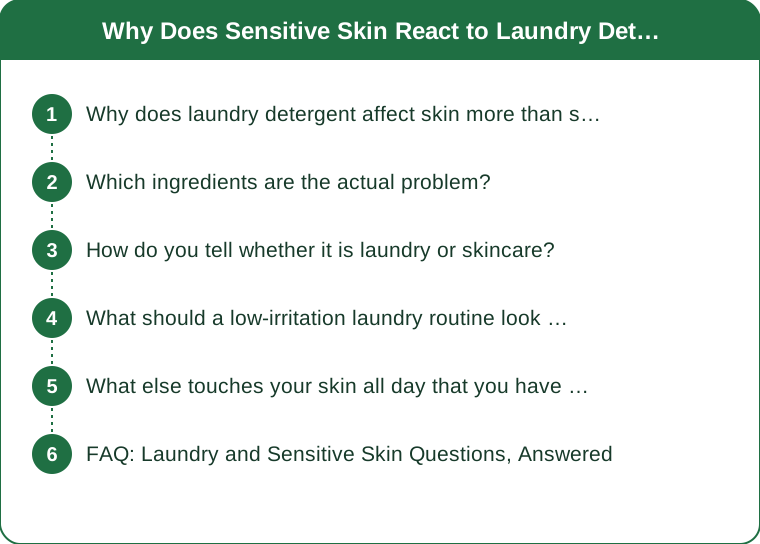
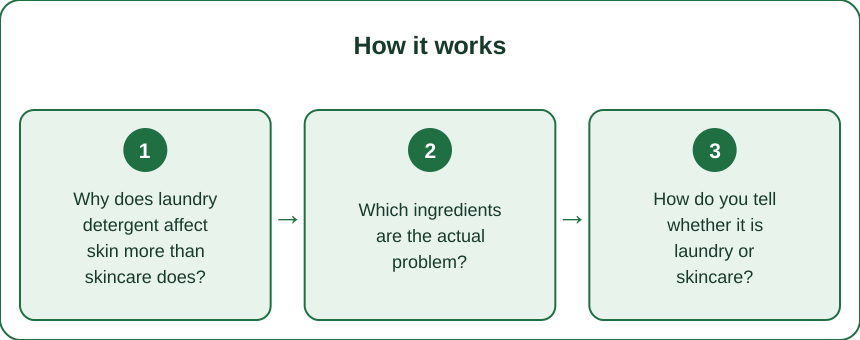
Why does laundry detergent affect skin more than skincare does?
Four reasons, and the first one dominates.
Contact time is enormous. A serum sits on your face for minutes before it absorbs or is washed off. A shirt sits against your skin for 16 hours, then pyjamas and bedding take over for the other eight. There is no comparable exposure in skincare.
Coverage is total. Detergent residue touches your entire body, including areas you never apply anything to and would not think to blame.
Friction and warmth increase penetration. Fabric rubbing on warm, slightly damp skin drives residues into the skin far more effectively than passive contact would.
Some ingredients are designed to stay. Fabric softener and fragrance are formulated specifically to survive the rinse and remain in the fibres. Optical brighteners bond to fabric deliberately — that is how they work.
Bedding is the biggest single exposure. Your face is pressed against a pillowcase for eight hours. For facial reactions with no obvious skincare cause, pillowcase laundering is one of the first things worth changing.
Which ingredients are the actual problem?
Four categories, roughly in order of how often they cause trouble.
Fragrance is the leading cause of contact reactions, in laundry products as in everything else. ‘Fragrance’ can mean dozens of individual compounds, any of which may be the trigger.
Fabric softener is the worst offender per use. It deposits a cationic coating on fibres that is intended to remain. It also reduces the absorbency and breathability of towels and activewear, which creates its own irritation.
Optical brighteners are fluorescent compounds that make whites look whiter by bonding to fabric. They stay in the fabric permanently by design, and they are a recognised contact sensitiser for some people.
Preservatives and enzymes in liquid detergents can also trigger reactions, though less frequently than fragrance.
Residue from over-dosing is a factor on its own. Using more detergent than needed — very common — leaves more in the fabric regardless of formula. Modern machines and concentrated detergents need far less than most people use.
Dryer sheets combine several of these — fragrance, softening agents and heat-driven deposition. They are the single easiest thing to eliminate.
How do you tell whether it is laundry or skincare?
The pattern of the reaction tells you more than any test at home.
Where does it appear? Torso, back, waistband line, bra line, inner thighs and behind the knees suggest fabric. Face, neck and hands suggest products.
Is it symmetrical and widespread? Contact reactions from clothing tend to be broad and symmetrical. Product reactions follow application areas.
Does it track with tight clothing? Reactions concentrated where seams, elastic and waistbands press are strongly suggestive of fabric contact plus friction.
Does it worsen overnight? Bedding exposure points at laundry.
Does it improve on holiday? Different bedding and different laundry with no change to your skincare is a useful natural experiment, and people often notice this without drawing the conclusion.
The definitive home test is a strip-and-reintroduce. Wash everything — clothes and bedding — with a fragrance-free, additive-free detergent, no softener and an extra rinse. Give it four weeks, since fabric holds residue through several washes. If things improve, reintroduce one variable at a time.
This is general information, not medical advice. Persistent, spreading or blistering rashes warrant seeing a doctor or dermatologist — patch testing can identify a specific allergen precisely, which guesswork cannot.

What should a low-irritation laundry routine look like?
Six changes, most of them free.
Switch to a fragrance-free, dye-free detergent without optical brighteners. ‘Free and clear’ style products, or dedicated sensitive-skin formulations.
Stop using fabric softener and dryer sheets entirely. If you want softness, wool dryer balls or a small amount of white vinegar in the rinse achieve it without deposition.
Use less detergent. Most people use two or three times what is needed. Follow the dose for your water hardness and load size, and reduce further if you have soft water.
Add an extra rinse cycle. This is the most underrated setting on any machine, and it removes a meaningful amount of residue.
Wash new clothes before wearing. New garments carry manufacturing finishes, dyes and sizing agents that are common irritants — this is why a brand new top can cause a reaction the first time and never again.
Prioritise bedding. If you change nothing else, change how your pillowcases and sheets are washed. It is the highest-contact fabric you own.
Seasonal note: reactions often worsen when the heating comes on, because dry indoor air compromises the skin barrier and a compromised barrier reacts to things it previously tolerated. The detergent did not change in October — your skin’s threshold did. If you are going to strip your laundry routine, autumn is the sensible time to do it.
What else touches your skin all day that you have not considered?
Beyond detergent, several everyday exposures beat skincare on contact time.
The fabric itself. Wool and some synthetics irritate mechanically rather than chemically. Cotton, bamboo and silk are generally better tolerated against reactive skin.
Dye in dark clothing. Disperse dyes used on synthetics are a recognised sensitiser, and reactions typically appear where fabric is tight and you sweat — waistband, bra line, inner thighs.
Nickel in fastenings. Jean buttons, bra hooks, zip pulls. A persistent small patch of irritation in one exact spot is almost always this.
Elastic and rubber components. Waistbands and bra elastic contain accelerators used in rubber processing, which are a known contact allergen group.
Your own sweat, held against skin. Damp fabric worn for hours is irritating in itself, independent of anything in it.
Three quick questions people ask here
Does washing new clothes really matter? Yes — manufacturing finishes are a common cause of first-wear reactions.
Is ‘hypoallergenic’ on a detergent meaningful? It is not a regulated term. Read the ingredient list for fragrance and brighteners instead.
Can I keep softener for towels only? Better not to — towels rub wet skin, which is the highest-transfer situation of all.
FAQ: Laundry and Sensitive Skin Questions, Answered
How long before I see an improvement?
Allow four weeks. Fabric holds residue through several wash cycles, so a single wash proves nothing.
Is fabric softener really that bad for sensitive skin?
It is the single most common laundry trigger, because it is designed to remain in the fabric. Wool dryer balls are the easy replacement.
What about ‘sensitive’ versions of scented detergents?
Check the ingredients. Many still contain fragrance at lower levels, which is enough for a genuinely reactive skin.
Should I wash bedding more often?
Weekly for pillowcases is a reasonable standard, more often during a flare. It is the highest-contact fabric you own.
Can hard water contribute?
Yes — it requires more detergent for the same result, which means more residue. A water softener or a dose adjusted for hardness helps.
Does an extra rinse actually help?
Yes, measurably. It is the cheapest single change available.
When should I see a doctor?
If the rash persists, spreads, blisters or affects your sleep. Patch testing identifies a specific allergen and saves months of guessing.
TL;DR:
- Laundry residue has 16 hours of contact daily across your whole body — far more exposure than any skincare.
- The usual triggers are fragrance, fabric softener and optical brighteners, all designed to stay in the fabric.
- Where the reaction appears is the best clue: torso, back and tight-clothing lines point at fabric.
- Strip the routine: fragrance-free detergent, no softener, less detergent, extra rinse — and give it four weeks.
- Start with bedding. It is the highest-contact fabric you own.
Wash your pillowcases with a fragrance-free detergent and an extra rinse this week. It is the smallest experiment with the biggest reach.
Keep Reading
This article is for general informational purposes only and is not medical advice. Always consult a qualified health professional for guidance specific to you.