Why Does Sensitive Skin Sting Only at Night?
Quick Answer: Skin barrier function follows a circadian rhythm — transepidermal water loss peaks in the evening and overnight, skin temperature rises, and barrier permeability increases. That means the same active ingredient penetrates faster and irritates more at 10pm than at 7am. Evening stinging is usually a timing problem, not a product problem, and moving the active to morning often resolves it entirely.
You apply the same serum you’ve used for months, at night, and your cheeks light up. In the morning, nothing. Most people conclude the product went bad or their skin is getting worse. Neither is usually true.
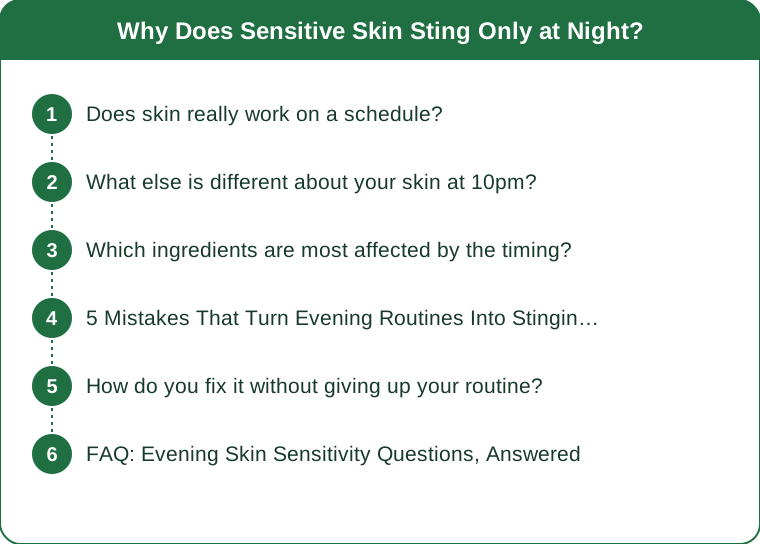
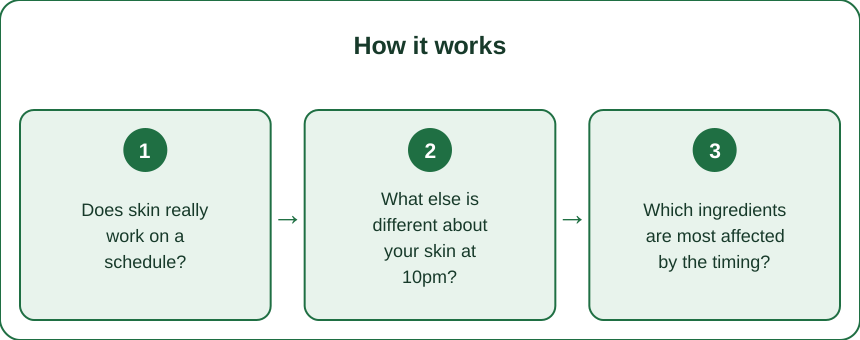
Does skin really work on a schedule?
Is there an actual circadian rhythm in skin?
Yes, and it’s well documented. Skin has its own peripheral clock genes. Transepidermal water loss — the rate at which water escapes through the barrier — rises through the evening and peaks in the night hours. Skin temperature and blood flow follow a similar pattern.
What does that mean for permeability?
A more permeable barrier means anything applied on top goes further, faster. That’s why some ingredients are recommended at night for efficacy — and exactly why they sting more.
Is that why night creams exist?
Partly, though the marketing runs ahead of the science. The genuine rationale is that overnight is a high-repair, high-permeability window. The unmentioned corollary is that it’s also the highest-reactivity window.
What else is different about your skin at 10pm?
Is temperature a factor?
A meaningful one. Core and skin temperature rise in the early evening before the pre-sleep drop, and warmer skin means faster chemical reaction rates and increased blood flow to the surface. Warm, well-perfused skin reports sensation more readily.
Does cleansing matter more at night?
Substantially. Evening cleansing is usually more thorough — removing sunscreen, makeup, and the day’s grime — which means more surfactant contact and a temporarily disrupted barrier at the exact moment you apply something active. Barrier recovery from a cleanse takes 20 to 60 minutes, and most people apply serum within two.
What about hot showers?
A significant and underrated contributor. Water above roughly 105°F strips barrier lipids and leaves skin acutely more permeable for the better part of an hour. An evening shower followed immediately by an active is a common recipe for stinging that morning routines simply don’t reproduce.
Which ingredients are most affected by the timing?
What stings most at night?
Low-pH actives and small-molecule penetrants. Retinoids, AHAs and BHAs, vitamin C in L-ascorbic acid form, and high-percentage niacinamide are the usual culprits. All of them are more bioavailable through a compromised or permeable barrier.
Aren’t retinoids supposed to be used at night?
The night recommendation is mostly about UV degradation of older retinoid formulations and about photosensitivity, not about efficacy requiring darkness. Modern encapsulated formulations are more stable. If a retinoid consistently stings at night and your dermatologist agrees, morning use with diligent sunscreen is a legitimate option.
What about fragrance and essential oils?
They follow the same rule and are worth eliminating first regardless of timing. Fragrance is the single most common trigger in reactive skin, and the evening barrier state amplifies it.
5 Mistakes That Turn Evening Routines Into Stinging Routines
1. Applying to damp, freshly cleansed skin. Damp skin absorbs actives far more readily. That’s great for hydrating layers and bad for anything acidic.
2. Layering three actives in one session. Each additional active compounds barrier stress. One per evening, at most.
3. Hot shower, immediate serum. Give it 20 minutes minimum. The single easiest change on this list.
4. Assuming stinging means it’s working. It doesn’t. Stinging is a barrier signal, and repeated stinging predicts a barrier that will get more reactive, not less.
5. Increasing frequency after a good week. Sensitive skin tolerance builds slowly and collapses quickly. Hold a frequency for four weeks before increasing it.
How do you fix it without giving up your routine?
What’s the first thing to change?
Move the active to morning for two weeks and change nothing else. If the stinging stops, you’ve confirmed timing as the cause and you’re done.
If I need it at night, what then?
Buffer it. Apply moisturizer first, wait ten minutes, then the active on top. This slows penetration and typically eliminates the sting while retaining most of the benefit. Or apply the active to fully dry skin 30 minutes after cleansing.
What if it’s stinging on everything, even plain moisturizer?
That’s a barrier that’s already compromised, and no timing adjustment fixes it. Stop all actives for two to four weeks, use a bland ceramide-containing moisturizer twice daily, cleanse with lukewarm water and a non-foaming cleanser, and let it rebuild before reintroducing anything.
This is general information, not medical advice. Stinging accompanied by visible rash, swelling, burning that persists past 20 minutes, or spreading redness should be seen by a dermatologist — that’s a reaction, not a timing issue.
FAQ: Evening Skin Sensitivity Questions, Answered
Why does it sting more some nights than others?
Barrier state varies day to day with sleep, humidity, hot showers, alcohol, and where you are in your menstrual cycle. Skin is measurably more reactive in the days before menstruation for many people, which explains a lot of otherwise mysterious weeks.
Does the season change this?
Yes. Indoor heating drops ambient humidity sharply from October onward, which raises transepidermal water loss and lowers tolerance across the board. Many people who tolerated a routine all summer start reacting in the first cold weeks — same routine, drier air.
Should I switch to a night-specific product line?
Not necessarily. What matters is the ingredient list and the order you apply things, not whether the label says night. A gentle product used at the right time beats a night-branded one applied to hot, damp skin.
TL;DR:
- Barrier permeability and water loss genuinely peak in the evening — actives penetrate more then.
- Hot showers and thorough evening cleansing leave skin disrupted for 20 to 60 minutes.
- Moving the active to morning, or buffering with moisturizer first, resolves most evening stinging.
- Stinging is a barrier warning, not a sign of efficacy; repeated stinging makes skin more reactive.
If your skin only complains after dark, it’s telling you about timing rather than about the product. Try the two-week morning swap before you throw anything away — a serum that stings at 10pm and behaves perfectly at 7am is the same serum, meeting a different barrier.
Keep Reading
This article is for general informational purposes only and is not medical advice. Always consult a qualified health professional for guidance specific to you.