Why Sensitive Skin Can Suddenly React to a Product You've Used for Months
Quick Answer: A product that’s been used safely for months can suddenly trigger a reaction due to a combination of factors — a weakened skin barrier from an unrelated cause (weather, illness, stress), a genuine cumulative sensitization building slowly over repeated exposure, or a reformulation the brand made without much visible change to the packaging — so ‘nothing changed’ often isn’t quite accurate even when it feels that way.
All three explanations are common enough to be worth ruling out before assuming the skin has simply ‘changed.’

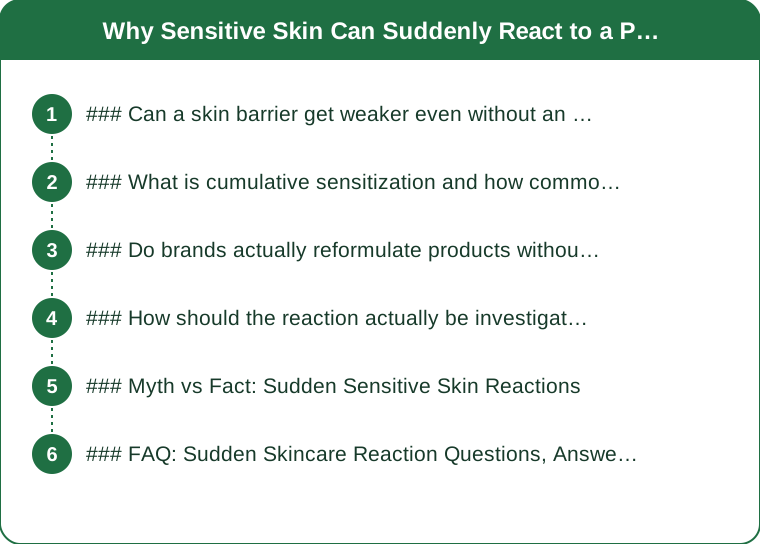
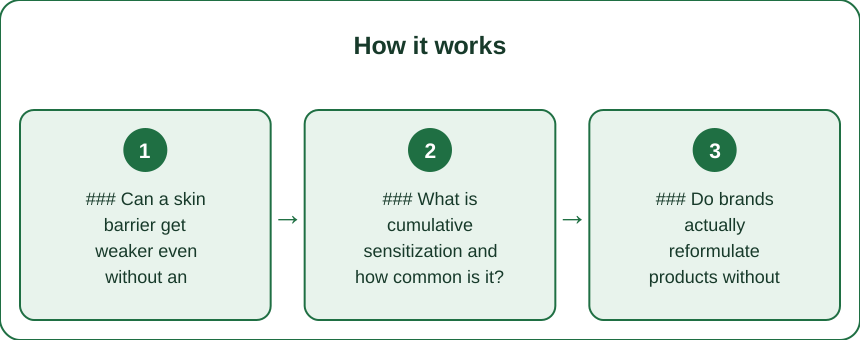
### Can a skin barrier get weaker even without an obvious cause?
Yes — barrier function is affected by sleep, stress, weather shifts, and even minor illness, none of which are always obviously connected to skincare. A weakened barrier lets a previously well-tolerated product penetrate more deeply or trigger more irritation than it did when the barrier was stronger, even though the product formula itself hasn’t changed at all.
### What is cumulative sensitization and how common is it?
Cumulative sensitization happens when repeated low-level exposure to an ingredient gradually builds an immune response over weeks or months, eventually crossing a threshold into a visible reaction. This is a genuine, documented phenomenon with certain preservatives and fragrance compounds — it’s less common than barrier-related reactions but real enough that it shouldn’t be dismissed just because the product was fine at first.
### Do brands actually reformulate products without clearly announcing it?
It happens more often than most consumers realize — minor formula adjustments (a different preservative system, a supplier change for a raw ingredient) don’t always trigger a new product listing or an obvious ‘reformulated’ label, especially for smaller changes that a brand doesn’t consider significant. Checking the ingredient list against an older photo or receipt, if available, can sometimes reveal a change that wasn’t otherwise announced.

### How should the reaction actually be investigated once it happens?
Stop using the product immediately and simplify the rest of the routine to a bare minimum (gentle cleanser, basic moisturizer) for at least a week to let the skin calm down before testing anything again. If the reaction was significant, patch-testing the product on a small area (like the inner forearm) before returning it to the full face routine is a safer way to confirm whether it’s truly the cause. This is general information, not medical advice — a dermatologist should be consulted for a persistent or severe reaction.
### Myth vs Fact: Sudden Sensitive Skin Reactions
Myth: if a product caused a reaction, it must have always been wrong for your skin. Fact: many reactions only emerge after a barrier weakens or sensitization builds — a product can genuinely be fine for months and then stop being fine, without either the product or the underlying skin type being wrong from the start.
Myth: ‘natural’ or ‘sensitive skin’ labeled products can’t cause this kind of delayed reaction. Fact: labeling doesn’t prevent cumulative sensitization or reformulation-related reactions — those risks apply regardless of how a product is marketed.
### FAQ: Sudden Skincare Reaction Questions, Answered
How long does barrier repair typically take once the trigger is removed?
Often 2-4 weeks of a simplified routine for a mild reaction, though more significant barrier damage can take longer and may benefit from a dermatologist’s input.
Is patch testing worth doing even for products already used for months?
Yes, specifically when reintroducing a product after a reaction — past safe use doesn’t guarantee current safety, especially if a barrier issue or reformulation is suspected.
Should every product in the routine be suspected, or just the most recently applied one?
Start with the most recently applied or most active product, but don’t rule out others entirely — sometimes a previously well-tolerated product becomes the trigger only once a barrier issue from something else is already present.
TL;DR:
- A weakened skin barrier from an unrelated cause can make a previously fine product suddenly react
- Cumulative sensitization to certain ingredients can build slowly and cross a threshold after months of use
- Brands sometimes reformulate without an obvious announcement, changing a ‘safe’ product quietly
- Stopping the product, simplifying the routine, and patch-testing before reintroducing it is the safest path forward
‘Nothing changed’ is rarely the full picture with a sudden reaction — barrier health, gradual sensitization, or a quiet reformulation usually explain what looks like an unexplained shift.
Keep Reading
This article is for general informational purposes only and is not medical advice. Always consult a qualified health professional for guidance specific to you.