Why Sensitive Skin Flares in Late August and What to Change First
Quick Answer: Late-August flares are a cumulative-load story: a summer of UV exposure, daily sunscreen layers, sweat sitting against skin, chlorine and salt water, and nonstop air conditioning has been quietly drawing down your skin barrier for weeks — and the barrier finally overdraws right as the season turns. The instinct is to hunt for the one guilty product; the arithmetic says the whole stack got heavier than your barrier’s budget. The fix runs in order: subtract before you add, rebuild the barrier with boring moisturization, keep the sunscreen but reconsider its formula, and only then — weeks later — reintroduce actives one at a time.
Here is what actually drained the account, and the recovery sequence that works.

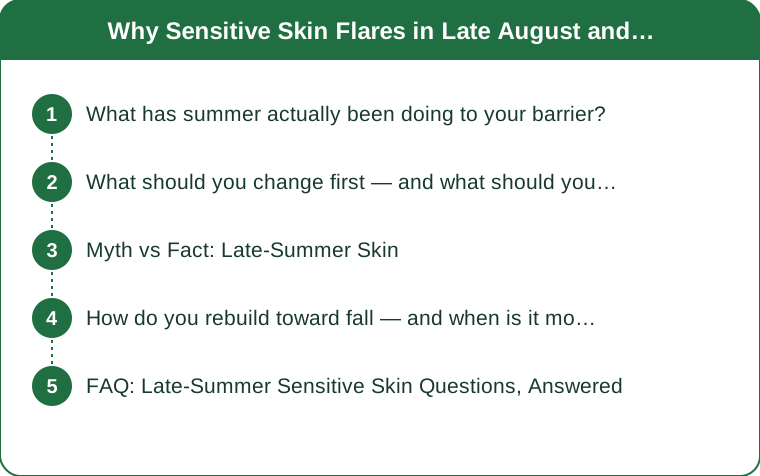
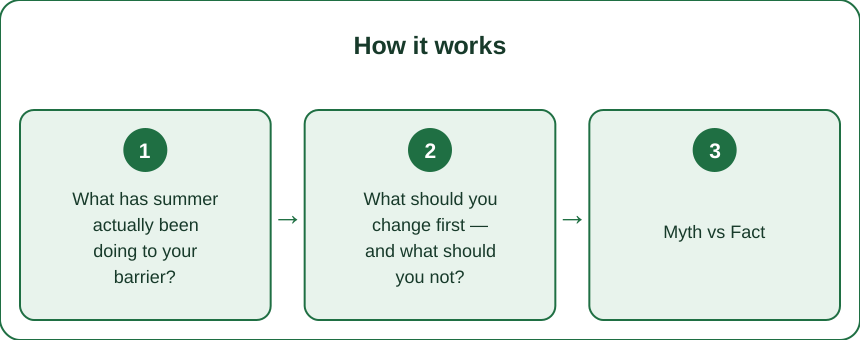
What has summer actually been doing to your barrier?
Five slow withdrawals, none dramatic alone, all landing on the same account.
Your skin barrier — the outermost layer of cells and lipids — is what keeps water in and irritants out. Sensitive skin is, functionally, skin whose barrier runs closer to its limit; anything that thins the lipid layer or raises its workload shows up as stinging, flushing, and reactivity to products that were fine in May.
UV is the compound interest. Even without a single burn, months of daily sun exposure generate low-grade inflammation and degrade barrier lipids. The damage is cumulative and delayed — which is why the reckoning arrives in late August rather than June, and why skin can flare weeks after your last beach day.
Sweat is an irritant when it lingers. Fresh sweat is fine; sweat sitting against skin for hours — under a hat band, along the hairline, wherever fabric holds it — concentrates salts and urea that provoke exactly the itchy, prickly flush sensitive skin knows well. A hot summer means your skin spent more hours marinating than any other season.
Sunscreen is essential and still a load. Three months of daily application, often multiple layers, plus the cleansing effort needed to remove it every night, is a real workload for a reactive barrier — especially chemical filters, which sting on compromised skin, and especially the extra cleansing, which strips lipids along with the SPF.
Chlorine and salt water strip lipids directly. Every pool and ocean session removes a little of the mortar; a swim-heavy summer removes a lot.
And air conditioning dehydrates from the other side. AC air is dry air, and three months of it steadily pulls water from the skin. Dehydrated barrier cells are worse at their job — which closes the loop: every other stressor hits harder because of this one.
No single villain. A stack. Which is exactly why the single-villain response — swapping one product for a new one — so often adds load to a barrier that needed less.
What should you change first — and what should you not?
Subtraction first, in a specific order. The rebuilding phase is deliberately boring, and the boredom is the treatment.
Step one: pause every non-essential active. Exfoliating acids, retinoids, vitamin C, scrubs, peel pads — all of it goes on hold for two to four weeks. These are fine tools for a healthy barrier and a tax on a compromised one; a flaring barrier cannot afford them and does not need them to recover. If your retinoid is prescription, that pause is a conversation with your prescriber, not a unilateral stop.
Step two: shrink the routine to three jobs. A gentle, non-foaming cleanse — once daily in the evening is enough for most sensitive skin; morning can be water. A bland, barrier-focused moisturizer — the unglamorous kind built on ceramides, glycerin, and petrolatum-adjacent occlusives — applied morning and night, on slightly damp skin at night. And sun protection. That is the whole routine for the rebuild window. Every additional product is a variable you cannot rule out and a load you do not need.
Step three: keep the sunscreen, adjust the formula. Quitting SPF to rest your skin hands UV — the biggest original stressor — an open door. The adjustment that helps reactive skin is switching to a mineral formula, zinc oxide especially, which sits gentler on compromised barriers than most chemical filters, and rinses off with less aggressive cleansing.
Step four: fix the mechanical habits. Rinse or wipe sweat sooner after workouts rather than letting it dry in place. Lukewarm water only — the hot rinse that feels good on a flushed face is a lipid stripper with excellent PR. Softer towel, blot not rub. A humidifier near the AC vent zone or the bedside if the air runs dry.
Give the subtraction phase two to four honest weeks. Most late-summer flares calm substantially on subtraction alone — which is also the proof of diagnosis: a flare that settles when the load lightens was a load problem, not a mystery allergy.

Myth vs Fact: Late-Summer Skin
Myth: a flare means one product is suddenly bad for you. Fact: usually the products stayed the same and the budget shrank. A barrier at capacity reacts to formulas it tolerated for years — the product is the trigger, the summer is the cause. The audit that matters is total load, not the newest bottle. True new-ingredient allergies exist, but they are the minority of August flares.
Myth: natural and clean formulas are gentler on sensitive skin. Fact: botanical extracts and essential oils are among the most common irritants and allergens in skincare — lavender, citrus oils, and fragrant plant extracts flare reactive skin constantly. The gentle aisle is the boring aisle: short ingredient lists, no fragrance natural or otherwise, formulas built for barrier repair.
Myth: stinging means it is working. Fact: on sensitive skin, stinging means it is irritating. The tingle-equals-active folklore has retired more barriers than any heat wave. Products in the rebuild phase should feel like nothing.
Myth: oily or breakout-prone skin should skip moisturizer during a flare. Fact: a compromised barrier loses water faster and often compensates with more oil — moisturization is how the barrier rebuilds regardless of skin type. The adjustment is texture — a lighter ceramide gel-cream rather than a heavy balm — not omission.
Myth: drink more water and the dryness solves itself. Fact: hydration status matters systemically, but barrier dehydration is mostly a surface-loss problem — water escaping through a thinned barrier into dry AC air. The fix is topical: humectants to attract water, occlusives to keep it, and time.
Myth: fall will fix it automatically. Fact: autumn removes some stressors and adds its own — dropping humidity, indoor heating, wind. A barrier still compromised in October meets those thinner, not thicker. The rebuild window is now precisely so the next season lands on a repaired wall.
How do you rebuild toward fall — and when is it more than a flare?
A four-week arc, then a careful reintroduction, with clear lines for when to stop self-managing.
Weeks one and two: the floor. The three-job routine, nothing else. Expect the first improvements in this order: stinging on application fades first, then the tight after-cleansing feeling, then the visible flush. Log it briefly — two lines nightly — because the log is what makes the next phase rational instead of vibes-based.
Weeks three and four: consolidation. If things are calming, change nothing. This is the phase people sabotage by celebrating early — the barrier that feels normal at day 18 is still under-built, and the active that returns at day 18 restarts the clock. Boring wins twice.
Reintroduction, one variable at a time. After a calm month, bring actives back one per one-to-two weeks, starting with whatever earns its place most — for most people the retinoid, at a lower frequency than before, buffered over moisturizer. Each addition gets its own trial window; anything that re-triggers goes back on the shelf for a longer wait. By October you have rebuilt a routine where every item re-qualified for the roster — which is, quietly, the best skincare audit there is.
The escalation lines, plainly: a rash that is spreading, blistering, weeping, or sharply painful; swelling of lips or eyes; a flare with fever or feeling unwell; suspected reactions to a new medication; or any flare that survives four weeks of genuine simplification — those are clinician visits, not routine adjustments. Likewise, recurring seasonal flares year after year are worth a dermatology appointment in a calm month: patterns like rosacea, seborrheic dermatitis, and true contact allergy masquerade as sensitive summers and each has real, specific treatment. Patch testing exists precisely to end the guessing.
This is general information, not medical advice — it describes a load-management approach, and your clinician outranks it on everything.
The encouraging arithmetic to end on: barriers rebuild in weeks when the withdrawals stop. The same skin sending August invoices is usually calm by the equinox — if the response is subtraction, patience, and one variable at a time.
FAQ: Late-Summer Sensitive Skin Questions, Answered
Can I wear makeup during the rebuild weeks?
Lightly, if removal stays gentle — the load is less the makeup than the cleansing needed to remove it. Favor formulas that leave with a single pass of a mild cleanser, skip the waterproof tier, and give the skin bare evenings when the calendar allows.
Which single moisturizer ingredient matters most?
No single hero — the pattern is the hero: a humectant to draw water (glycerin, hyaluronic acid), barrier lipids to patch the wall (ceramides, cholesterol), and an occlusive to slow the loss (petrolatum, dimethicone, squalane). Most well-regarded barrier creams are variations of exactly that trio, fragrance-free.
Is it the sunscreen itself making me sting?
Possibly — chemical filters sting readily on a compromised barrier, and that stinging is usually irritation rather than allergy. The practical test: switch to a plain zinc oxide formula for two weeks. If stinging stops, keep mineral through the rebuild; if it persists across formulas, the barrier is the patient, not the SPF.
My flare is mostly where my hat and sunglasses sit. Coincidence?
Not at all — occlusion plus sweat plus friction is its own mini-flare recipe, and the hat band, bra band, and sunglasses bridge are its favorite addresses. Wash the gear, loosen the fit where possible, and rinse those zones sooner after sweating; localized flares at contact points often resolve on mechanics alone.
TL;DR:
- August flares are cumulative: months of UV, lingering sweat, sunscreen-plus-cleansing workload, pool water, and AC dryness overdraw the barrier together — the newest product is rarely the real cause.
- Fix by subtraction first: pause all actives, run a three-job routine — gentle cleanse, boring barrier moisturizer, mineral SPF — for two to four weeks.
- Skip the myths: natural is not gentler, stinging is not working, and oily skin still needs moisturizer during a flare.
- Reintroduce actives one at a time after a calm month, and escalate to a clinician for spreading, blistering, month-long, or every-summer patterns.
Tonight, put the acids and retinoids in a drawer with a date four weeks out written on a sticky note. The most effective product in your routine this month is the shelf.
Keep Reading
This article is for general informational purposes only and is not medical advice. Always consult a qualified health professional for guidance specific to you.