Why Sensitive Skin Reacts Days After Trying a New Product, Not Immediately
Quick Answer: Delayed skin reactions happen because some irritants (especially fragrance and certain preservatives) trigger a slower immune response than the fast contact irritation a 24-hour patch test catches. A longer patch test window — closer to 5-7 days — catches more of these delayed cases.
You did everything right: patch tested on your inner arm, waited a full day, no redness. Applied it to your face, and four days later you’re dealing with a breakout or rash. This isn’t a testing failure on your part — it’s a gap in how most patch-test advice describes timing.

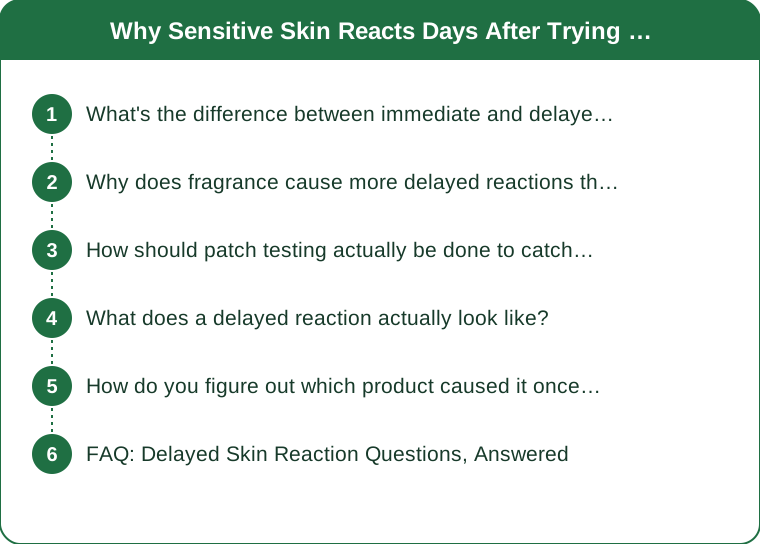
What’s the difference between immediate and delayed skin reactions?
Immediate (irritant) reactions show up within minutes to hours and are usually caused by a direct chemical irritation. Delayed (allergic) reactions involve your immune system recognizing an ingredient over repeated or extended exposure, which can take 3-7 days to appear even on a first use — a standard 24-hour patch test misses this category entirely.
Why does fragrance cause more delayed reactions than other ingredients?
Fragrance compounds are a leading cause of delayed contact allergy specifically because the immune sensitization process (rather than direct irritation) is often how fragrance triggers reactions — this is part of why ‘fragrance-free’ matters more for sensitive skin than ‘unscented,’ which can still contain masking fragrance.
How should patch testing actually be done to catch this?
Apply the product to a small area (inner arm or behind the ear) daily for 5-7 days, checking each day, rather than a single 24-hour test. This mimics real repeated exposure and catches the slower immune-mediated reactions that a one-time test misses entirely.

What does a delayed reaction actually look like?
Often subtler than an immediate reaction — mild itching, small bumps, or dryness that develops gradually rather than sudden obvious redness. Because it’s gradual, people often blame something else (weather, diet, stress) before connecting it back to a product introduced days earlier.
How do you figure out which product caused it once you have several new ones going?
Introduce one new product at a time, ideally with several days between additions, specifically so a delayed reaction can be traced back clearly. Adding 3 new products in the same week makes this kind of detective work nearly impossible after the fact.
FAQ: Delayed Skin Reaction Questions, Answered
Should I stop a product immediately if I suspect a delayed reaction?
Yes — discontinue use and let skin recover before testing further, and consider seeing a dermatologist if the reaction is significant or doesn’t resolve within a week or two.
Are natural or ‘clean’ products less likely to cause delayed reactions?
Not necessarily — several natural fragrance and preservative alternatives are also known sensitizers; ‘natural’ doesn’t equal lower reaction risk for sensitive skin specifically.
Can a product I’ve used for months suddenly cause a delayed reaction?
Yes — sensitization can build up over repeated exposure over time, which is why a product that worked fine for months can start causing reactions later. This is general information, not medical advice.
TL;DR:
- Delayed reactions come from immune sensitization, not direct irritation, and can take 3-7 days to appear
- A single 24-hour patch test misses this category — extend testing to 5-7 days for new products
- Fragrance is a leading cause specifically because of this delayed immune mechanism
- Introduce one new product at a time so a delayed reaction can actually be traced
A clean 24-hour patch test isn’t a guarantee — give sensitive skin the full week before fully trusting a new product.
Keep Reading
This article is for general informational purposes only and is not medical advice. Always consult a qualified health professional for guidance specific to you.